
Florissant City Directory Collections
Florissant researchers use the St. Louis County Library History & Genealogy collection as the main regional shelf. Its holdings distinguish St. Louis City from St. Louis County, an important difference for an old Florissant directory search. The verified county run is not continuous, and formats vary by year. Some editions are microfilm, some are print, and selected county volumes can be searched as free digital scans without a library card. Treat each volume as a snapshot from its publication year, not as a complete roll of every person who lived in Florissant.
| Directory collection | Verified years | Holding location | How to use it |
|---|---|---|---|
| St. Louis County directories | 1893, 1896, 1903, 1909, 1917, 1920, 1922, 1923, 1930, 1932 | St. Louis County Library | Format and call number vary by volume |
| 1896 county directory | 1896 | SLCL print shelf | Call number R 917.7865 S145 |
| 1903 county directory | 1903 | SLCL microfilm and print | Call number R 917.7865 A694 |
| Haines Criss-Cross City and County directories | Individual editions vary | SLCL reference collection | Address-first research, call number R 917.7865 H153 |
The SLCL History & Genealogy department identifies many useful companions: maps, atlases, plats, newspapers, yearbooks, burial records, court material, naturalization files, church records, funeral records, and microfilm. Those sources help test whether a directory name and address belong to the same person.
The library collection is a research hub rather than a single directory database, so record the exact title, year, page, and city or county label used for each finding.
Florissant City Directory Years
The SLCL directory holdings list is the first check for a particular year. It confirms 1893 on microfilm, 1896 in print, 1903 in microfilm and print, then the county years 1909, 1917, 1920, 1922, 1923, 1930, and 1932 with formats that differ by entry. It does not establish that these are the only editions ever printed. It establishes what this library has listed and how a researcher may need to consult it.
Review the City and County directory holdings before planning a visit or requesting help.
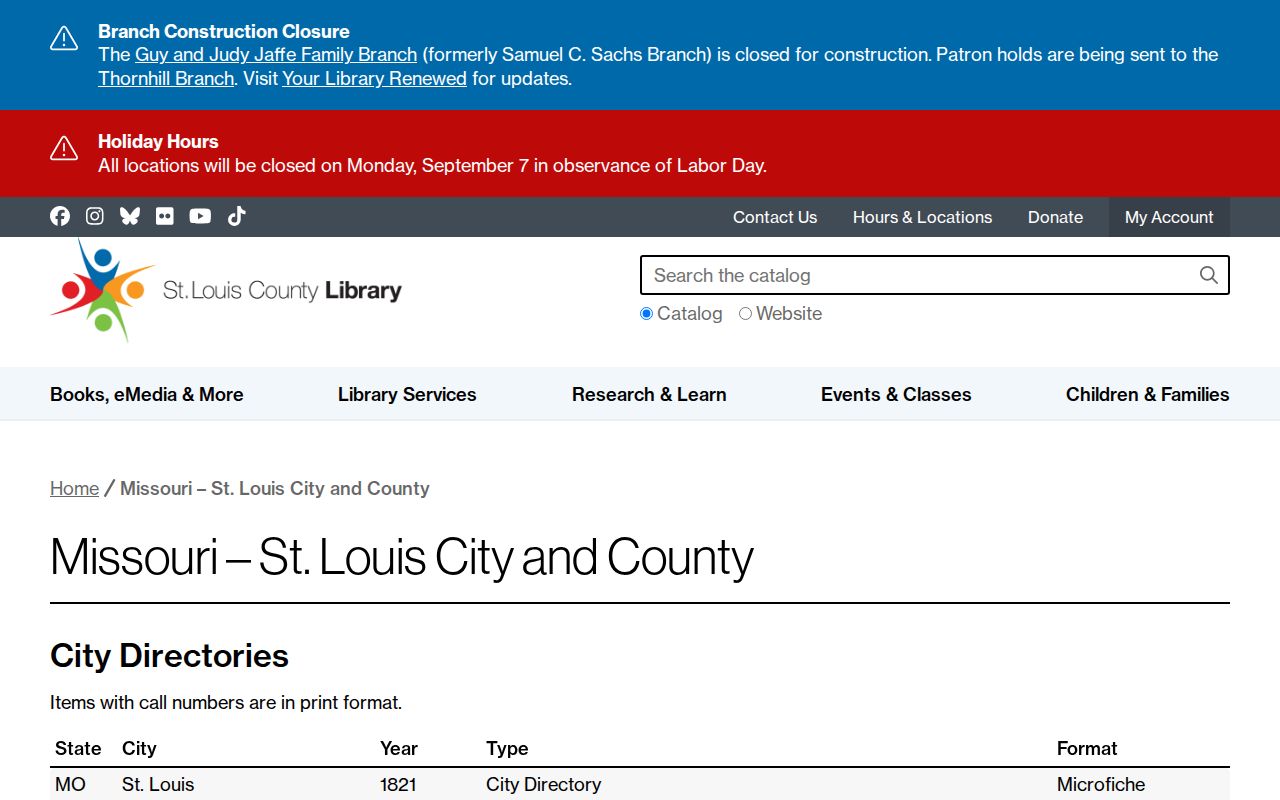
A missing year in the list is a gap in the located holdings, not proof that a Florissant household moved or disappeared. Check nearby years and other record types before drawing a conclusion.
Digitized Florissant Directories
The library’s digitized St. Louis County Directories are free and do not require a card. Select the county collection, choose a year, then try a surname or part of an address. The books are alphabetized by surname. Search text can help find a page, but OCR can miss names or misread old type, so the scan is the evidence to preserve.
- Choose the year nearest the known Florissant event, address, or family record.
- Search the surname and reasonable spelling variants, then try a portion of the street address.
- Open the scanned page and read the surrounding entries, not only the highlighted text.
- Save the volume title, year, page image, and its St. Louis City or County label.
Open the digitized county directory search when an online scan is available for the needed edition.
A text hit starts the research. Page browsing catches split columns, abbreviations, and OCR errors that a search box cannot explain.
Note: A directory result is dated evidence, not a present-day address or a complete household list.
Reading Florissant Directory Entries
In a Florissant directory entry, the reliable fields are the ones printed in that particular volume. A typical listing may give a name, an occupation or business, and an address. The collection notes warn that omissions, transcription mistakes, reused addresses, and household changes occur. Do not supply a spouse, owner status, relationship, or later address unless the page itself or a second source supports it.
Read the entry in the context of the page. A Florissant surname may appear beside similar names, and the original column can clarify whether an abbreviation belongs to the person, a business, or the address.
| Name | Use the spelling printed in the volume, then search variants separately. |
|---|---|
| Occupation or business | A dated work or business reference, not proof of a current identity. |
| Street address | A publication-year address that may have been reused or renumbered later. |
| Page image | The check against OCR, column breaks, and abbreviated text. |
- Reverse directory
- A directory arranged by street and house number, useful when an address is known before a name.
- Criss-cross directory
- A separately published street-order directory. SLCL identifies the Haines City and County series at R 917.7865 H153.
- Index versus scan
- An index or OCR hit points to a page. The scanned page supplies the original printed context.
Florissant Directory Address Clues
Reverse directories appeared in some city directories by the early 1900s. They arrange residences by street and house number rather than by surname, sometimes dividing streets by neighborhood or municipality. That makes them useful when an old Florissant address is known but the household name is not. Find the street-number entry, follow the listed name to the surname portion or another directory, then compare it with a deed, newspaper, cemetery, or obituary source.
The Haines Criss-Cross City and County series is the strongest located address-to-occupant lead for this area. It is not title proof and does not establish current occupancy. For a modern parcel and deed chain, use the separate Florissant street directory records path.
Florissant Directory Custody History
Historical jurisdiction matters as much as spelling. Florissant’s first local government dates to 1786. Before the 1877 Great Divorce, St. Louis County included the present City of St. Louis. The split changed custody, so a pre-1877 item described as county material may now be held by a City of St. Louis office. The library recommends checking that historical boundary before assuming a county catalog covers every early Florissant record.
- 1786: Florissant’s first local government dates to this year.
- 1877: The City and County separation changed which custodian may hold older records.
- 1910: Statewide Missouri birth and death recording begins, while earlier county registers remain incomplete.
This history also explains why historic names such as Fleurissant and St. Ferdinand can be worthwhile search variants. Preserve the original spelling from each Florissant directory rather than silently modernizing it.
Florissant Directory Family Trail
Tracing a household works best as a dated chain. Start with one verified entry, follow it through the available county years, and describe each change plainly. A vanished listing may mean a move, a death, an omission, or a volume that did not cover the same area. It does not answer the question alone. Pair directory years with census releases and with library newspapers or burial sources when the trail needs a second independent record.
- Locate the earliest verified name-and-address entry in a listed year.
- Move forward through the next available editions, noting spelling, address, and occupation changes.
- Use a reverse or criss-cross listing when the address is the stronger starting point.
- Compare the dated entries with a census, deed, newspaper, cemetery, church, or funeral source.
- Record uncertainty when two people have the same name or the address changes hands.
For a Florissant household, keep a simple sequence of volume year, printed spelling, address, page, and the second source used to test the match. That note preserves the difference between evidence and a reasonable research lead.
Florissant Birth and Naturalization Leads
County birth registers can fill part of the gap before statewide registration. The SLCL birth-record index covers more than 3,300 county births from 1883 through 1895 and more than 200 stillbirths from 1883 through 1908. Both indexes are incomplete. They are leads for identifying a date or family connection, not substitutes for a certified vital record.
Check the library’s historical birth-index information before making a limited lookup request.
For naturalization, Missouri Archives indexes 1816 to 1955 but notes incomplete county indexing. The NARA Kansas City finding aid adds St. Louis District declarations from 1870 to 1929 and petitions from 1868 to 1991, plus Circuit Court series with earlier ranges.
Florissant Obituary Lookup Routes
When a directory trail stops, an obituary or newspaper lookup can provide a date, a place, or a different spelling to test. The library lookup service lists obituary sources including the Post-Dispatch, Globe-Democrat, Republic, Star-Times, and Westliche Post. An exact death date or a prior citation makes a request more useful. The library may limit some services to up to three source lookups, and fragile directories may not be photocopied.
Review SLCL’s obituary and genealogy lookup guidance before submitting a narrowly defined request.
A citation from a directory, page scan, newspaper, or archive should retain its title, date, page or reel reference, and the exact name spelling returned by the custodian.
Florissant Digital Archive Context
SLCL’s Digital Archives continues to expand the number of useful cross-checks around a Florissant directory. A November 2025 PastPorts update reported more than 6,600 items, 200 or more yearbooks added during August and September, 48 new directories, and the Watchman-Advocate among newly available material. A May 2026 update reported additions including early St. Louis city directories, census books, and St. Charles phonebooks. Availability changes, so verify the live collection before citing a page.
The St. Louis Genealogical Society is a second regional fallback when a Florissant family trail crosses city and county lines. Its Emerson Center reference room is at #4 Sunnen Drive, Suite 140, St. Louis, with listed Tuesday, Thursday, and Saturday hours of 9 a.m. to noon and telephone 314-647-8547. Its surname files, books, microfilm, microfiche, and indexed regional material can help locate a source that is not digitized.
For an offline fallback, SLCL reference services offers staff consultation, digital microfilm or microfiche readers, and scanning or copying subject to collection and security rules. Historic Florissant at 1067 Dunn Road, 314-921-7055, is another local-history lead, but its detailed public catalog, fees, and reading-room policy were not located. Note: An absent OCR match calls for page browsing, microfilm, or staff help, not an assumption that no record exists.